

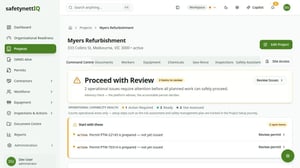
Critical risk intelligence is the governed process of connecting work and risk context, applicable requirements, critical controls and trustworthy evidence so authorised people can see uncertainty, act on gaps, verify change and make explainable assurance decisions.
It is not another dashboard, a larger risk register or a promise that work is safe. Its purpose is to help people make better decisions about the conditions that could lead to serious harm, while keeping the evidence, authority and verification behind those decisions visible.
What makes a risk “critical”?
In practice, organisations use the term critical risk for unwanted events with the potential for fatal or other severe consequences. The label should not be applied by software alone. It requires competent people to consider the work, credible pathways to harm, applicable requirements and the controls that must perform when they are needed.
The emphasis is consequence-led, but that does not mean likelihood, exposure or changing conditions can be ignored. A low-frequency event may still demand close attention when its potential consequence is catastrophic and control failure could leave little opportunity to recover.
Data, activity and intelligence are not the same thing
WHS systems can produce large volumes of data: completed inspections, actions, permits, training records, observations and incident reports. Those records may be useful, but volume is not evidence that a critical control is effective.
- Data is an individual observation, record or measurement.
- Information gives that data context, such as the work, location, control, owner and time.
- Activity shows that something was done, such as an inspection being completed.
- Intelligence connects relevant information and uncertainty to a decision an authorised person can explain.
A completed action is therefore not the same as verified control restoration. Closing a task may record administrative completion. Assurance requires evidence that the required condition has actually been restored and independently checked where appropriate.
The context-to-assurance operating loop
Governed critical risk intelligence can be understood as a six-part operating loop.
- Establish the work and risk context. Define the task, location, people, equipment, operating conditions and credible unwanted events. Context matters because the same control can perform differently as work changes.
- Identify applicable requirements and critical controls. Make clear which legal, technical, organisational and site requirements apply, which controls are critical and what acceptable performance looks like.
- Gather trustworthy evidence. Preserve the source, owner, time, status and confidence of evidence. Missing, stale, failed or contradictory evidence should remain visible.
- Assess control health and readiness. Compare evidence with defined control requirements. Avoid averages that allow many low-value green items to conceal one failed critical condition.
- Govern action, escalation and decision. Route gaps to people with the authority and competence to act. Record what was decided, by whom, on what evidence and with what limitations.
- Verify, assure and learn. Confirm that change occurred, test whether controls perform in practice and use the findings to improve the system.
Safe Work Australia describes WHS risk management as identifying hazards, assessing risks where required, controlling risks and reviewing controls, with worker consultation throughout. Critical risk intelligence does not replace that process. It helps preserve the context, evidence, authority and verification needed to make the process visible and explainable.
Why dashboards and completed forms are not enough
A dashboard can simplify complex information, but simplification creates risk. A green status may hide an overdue verification, an unresolved contradiction or evidence collected before conditions changed. A form may be complete even though the control it refers to was unavailable, bypassed or unsuitable for the work.
For critical conditions, decision-makers need a traceable path back to the underlying evidence. They should be able to see:
- what requirement or control is being assessed
- where the evidence came from and who supplied it
- when it was collected and whether it remains current
- whether the evidence passed, failed, is missing or is uncertain
- what conflicting information exists
- who is authorised to decide and what happened next
- whether corrective action was later verified.
This is why critical conditions should be treated worst-first. A failed, missing or unknown critical requirement should not disappear inside an overall percentage or traffic-light average.
What trustworthy evidence looks like
Trustworthy evidence is fit for the decision being made. It is not automatically trustworthy because it is digital, recent or accompanied by a photograph. Its strength depends on relevance, source, integrity, timing and the competence of the person interpreting it.
Useful evidence may include direct observation, measurements, test results, photographs, maintenance or inspection records, worker input and verified system records. Different evidence types can support each other. They can also conflict. A governed system keeps that conflict visible so an accountable person can investigate rather than allowing the software to select the most convenient answer.
Safe Work Australia’s guidance on reviewing controls reinforces the need to review controls when they are not working effectively, when conditions change, when new risks are identified or when consultation indicates that a review is needed.
Human authority and the role of AI
AI can help organise records, identify inconsistencies, retrieve relevant context, summarise evidence and draw attention to gaps. It should not approve work, determine legal compliance, certify that a control is effective or replace competent professional judgement.
The governing principle is simple: AI assists; accountable people decide. Any AI-supported output should be traceable to its sources, presented with appropriate uncertainty and reviewable by the person who carries the authority to act.
Workers, supervisors and consultation
Critical risk intelligence is not an executive reporting exercise conducted at a distance from the work. Workers often know where procedures and operating reality diverge. Supervisors see changing conditions, competing priorities and early signs of control degradation.
WHS consultation duties require workers and health and safety representatives, where applicable, to be consulted when hazards are identified, risks are assessed and decisions are made about controls. A governed intelligence process should make their input part of the evidence and preserve how it influenced the decision.
An illustrative critical control decision
The following example is illustrative and uses synthetic circumstances.
A planned task requires a permit and verified isolation before work begins. The permit record is complete, but the latest field evidence identifies a discrepancy between the isolation point shown in the record and the equipment present at the workface.
An activity-based dashboard might show the permit as completed. A governed intelligence process keeps the contradiction visible, prevents it being averaged away, routes it to an authorised and competent person, records the decision and requires fresh evidence before the control is treated as restored. The system supports the decision; it does not make the decision.
What leaders should ask to see
Leaders need concise information, but they also need enough evidence to challenge what they are being told. Useful questions include:
- Which critical controls are failed, missing, unknown or supported by stale evidence?
- What has changed in the work or operating context since the last verification?
- Where do records, field evidence and worker accounts contradict one another?
- Who has authority to accept, stop, escalate or restore the condition?
- Which actions are merely closed and which have been independently verified?
- What assumptions or evidence limitations affect the current decision?
ICMM’s 2026 Critical Control Management guidance provides an industry example of a structured process: identify unwanted events, select critical controls, define performance, assign accountability, implement, verify, evaluate and improve. It is not Australian law, but the sequence illustrates why critical controls require defined performance, accountable ownership and verification.
Measures that support better decisions
No single metric proves that controls are effective. A balanced view may include:
- evidence completeness and currency for critical controls
- time from a critical gap being identified to an authorised decision
- time from action to verified control restoration
- missing, failed and contradictory evidence detected
- critical gaps closed with verification
- repeat control degradation and the learning that followed.
Activity measures such as inspections completed, actions closed and training attendance can still be useful. They should be reported as activity, not treated as proof of control performance or safety outcomes.
How SafetyNettIQ approaches critical risk intelligence
SafetyNettIQ, powered by Work Safety Hub, is positioned around governed critical risk intelligence and assurance. It connects work context, requirements, critical controls and trustworthy evidence so authorised people can see gaps, act, verify and decide.
It does not replace accountable people, professional judgement or applicable legal, engineering and certification processes.
Book a tailored SafetyNettIQ demonstration to follow one critical risk workflow from context to assurance in your organisation’s operating environment.
Prefer to understand the approach first? Explore SafetyNettIQ’s governed context-to-assurance approach, then read our guide on how to evaluate critical risk management software.
Frequently asked questions
Is critical risk intelligence the same as a risk register?
No. A risk register records identified risks and treatments. Critical risk intelligence connects current work context, defined critical controls, trustworthy evidence, uncertainty, authorised decisions and verification. A risk register may be one source within that process.
Does critical risk intelligence determine that work is safe or compliant?
No. Neither a software platform nor an AI output should make that determination. Competent and authorised people must consider the evidence, applicable requirements and operating context, and use the appropriate legal, technical and professional processes.
What is the difference between a completed action and verified control restoration?
A completed action records that a task was closed. Verified control restoration requires evidence that the required condition now exists and, where appropriate, that it has been independently checked.
How should AI be used in critical risk intelligence?
AI can assist with retrieval, organisation, comparison and gap detection. Its outputs should remain traceable, reviewable and subject to human authority. AI should not approve work, determine compliance or conceal uncertainty.
What should leaders ask to see?
Leaders should ask for the current critical control condition, the evidence and uncertainty behind it, any failed or contradictory information, the accountable decision-maker, the action taken and proof that restoration was verified.